Handwritten checks, without the headache.
Every firm has that client: the register full of handwritten checks, the scans at an angle, the payee that might say two different names. Here is why this input is uniquely slow, and how to handle it at volume.

Why handwriting breaks the usual shortcuts.
Most data entry shortcuts assume printed text: bank feeds skip paper entirely, CSV exports only exist for the electronic side, and generic extraction tools are built for type, not cursive. A handwritten check defeats all of them at once. What is left is the oldest workflow in the profession: a person, a scan, a zoom button and a best guess at whether that is “Alvarez” or “Alvarado.”
The cost is not just the reading. Handwritten items cluster in exactly the accounts that need care, contractor payments, rent, owner transactions, so a misread payee is not a typo, it is a misclassification that survives until someone questions the P&L.
What actually helps, whatever tools you use.
Use the statement's own check images
Consistent, dated and matched to amounts: far better input than a shoebox of loose scans.
Amounts first, payees second
The amount and check number tie to the statement even when the handwriting does not. Lock the math, then resolve names.
A payee list per client
The same twenty names recur. A standing list, with the client's spelling quirks, turns guessing into matching.
Batch them
Reading handwriting has a warm-up cost. Ten checks in one sitting beat ten checks across ten interruptions.
A short exception list
Two or three truly unreadable items a month is a client question, not an afternoon of forensics.
Review, do not read
At volume, the person should check the reading, not do it.
At volume, reading has to leave the human.
The steps above make a manual workflow humane. They do not make it scale. Past a certain volume the only real fix is that a person stops being the reader and becomes the reviewer.
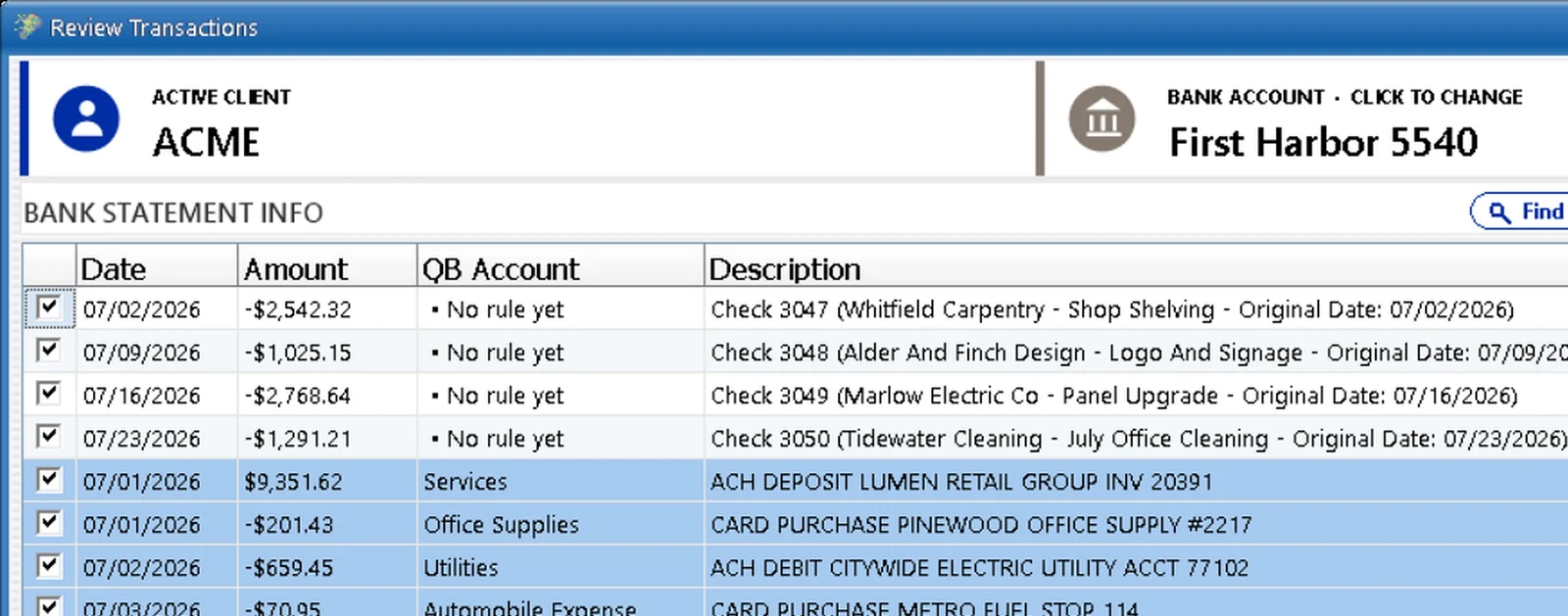
Every check arrives with its payee and memo
QBuddy reads handwritten checks along with the rest of the statement, matches them to the statement's own numbers, categorizes them by your rules and proves the month with BalanceProof before posting to QuickBooks Online or any Desktop version.
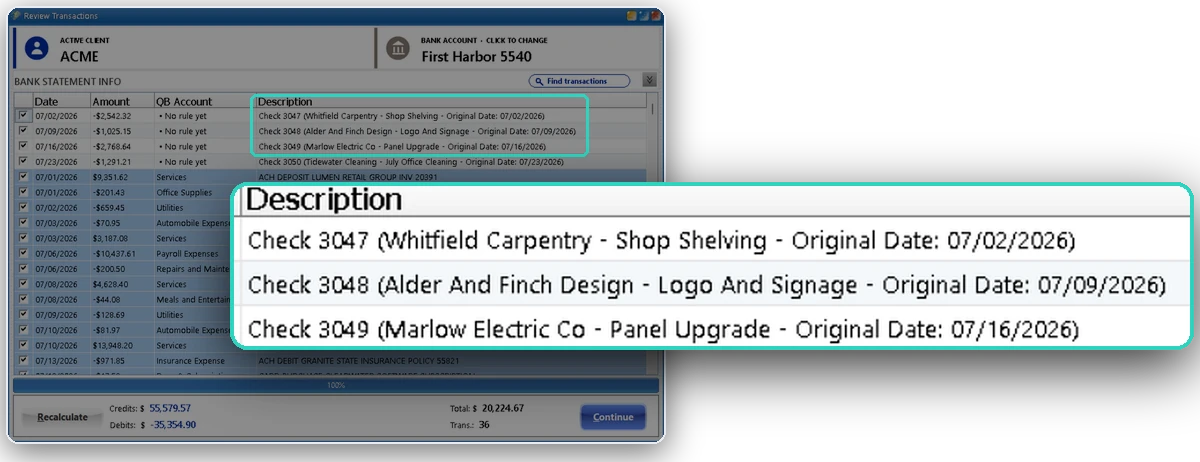
The screens on this page are QBuddy with a sample firm and invented data.
A quick self-test.
Count how many minutes your team spent last month reading handwriting. If the answer is “nobody tracks that,” that is the answer: it is hiding inside the close. Time it once, for one client, and you will know whether this guide's manual tips are enough or whether the reading itself has to go.
See it on your own statements.
Book a 15-minute demo and bring the messiest statement you have. We will run it live.